
The A50L takes a different approach from the rest of our animal range: instead of one fixed load per cycle, it’s designed for near-continuous loading throughout the burn. That makes it a better fit for larger poultry and mixed-livestock sites generating a steady stream of waste through the day, rather than a single batch that arrives all at once.
Waste goes in through an oversized front-loading door, or through an optional top hopper paired with a bin tipper for hands-off reloading during the cycle. Over a typical 16-hour run, that adds up to roughly 680 average-sized chickens, or the equivalent in sheep, pigs, or cattle — a considerably higher daily total than our fixed-load models, even though the machine itself has a more compact chamber.
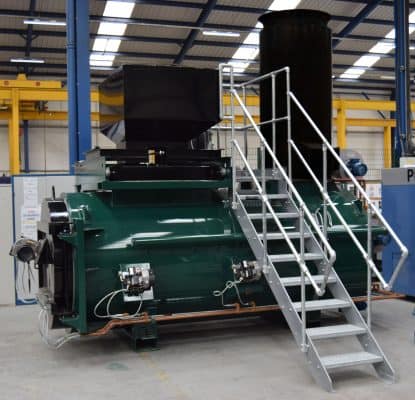
Key Benefits
- Near-continuous reloading during operation, rather than one load per cycle
- Oversized front-loading door for straightforward manual loading
- Optional top hopper and bin tipper combination for automated, hands-off reloading
- Cylindrical primary chamber designed around this continuous-loading process
- Simple restart between cycles — clear the ash, and the next burn begins
- Runs on diesel, propane, natural gas, or biofuel
Specifications Snapshot
- Burn rate: up to approximately 100 kg/hr
- Chamber volume: approximately 3.26 m³
- Total capacity per 16-hour cycle: approximately 2,000 kg (roughly 680 chickens, 10 sheep, 10 pigs, 5 bacon sows, or 2 cows)
- Loading method: front door, or top hopper with bin tipper
- Fuel options: diesel, LPG, natural gas, biofuel
Ideal For
- Larger poultry operations with steady, ongoing waste generation
- Mixed-livestock farms wanting to avoid multiple batch cycles per day
- Sites already using a bin tipper for other material handling
- Fuel options: diesel, LPG, natural gas, biofuel
Frequently Asked Questions
How is the A50L different from a fixed-load model like the TB-AB?
The TB-AB takes one 2,000 kg load and runs a single cycle. The A50L takes smaller amounts continuously throughout a longer burn, reaching a similar total daily volume but spread across the day rather than loaded all at once.
Do we need a bin tipper to use the A50L?
No — the front-loading door works fine for manual loading. The top hopper and bin tipper combination is an option for sites that want to automate reloading, not a requirement.
Is 16 hours the maximum cycle length?
16 hours is a typical reference cycle for reaching the approximate 2,000 kg daily figure — actual run time depends on how the site chooses to operate it. We can talk through a schedule that matches your waste generation pattern.
Call to Action
If your site generates waste steadily throughout the day rather than in one batch, tell us your daily volume and current loading setup — the A50L’s continuous-loading design might be a better operational fit than a fixed-load machine.
Speak to our team today!